

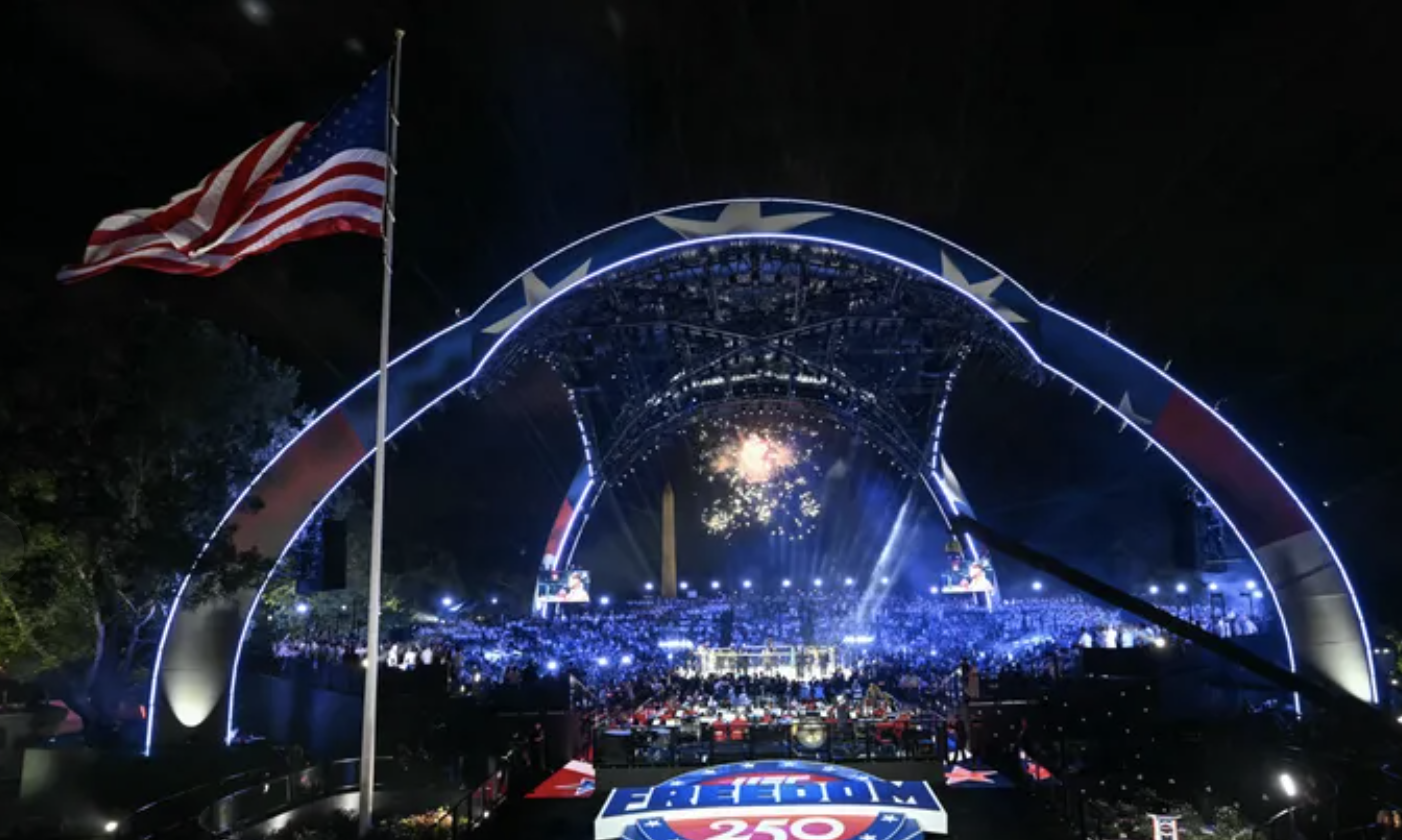
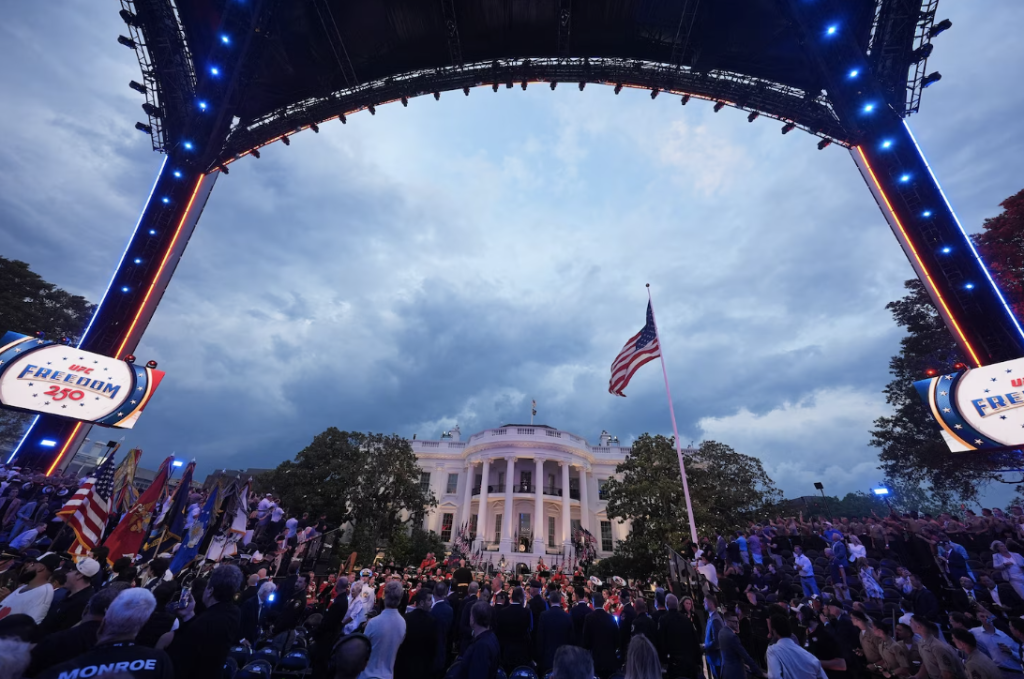
For the first time in American history, the White House South Lawn turned into a UFC arena, complete with an eight‑sided cage. The UFC Freedom 250,” doubled as a celebration of the country’s upcoming 250th anniversary and President Donald Trump’s 80th birthday.
Seven bouts played out under a canopy structure nicknamed “The Claw,” built over a regulation UFC Octagon just steps from the Oval Office. The card featured fighters from five countries and culminated in a lightweight title fight between undefeated champion Ilia Topuria and American challenger Justin Gaethje.
How a South Lawn turned into “Fight Night at 1600”
The South Lawn has long hosted Easter Egg Rolls and turkey pardons, but never a cage fight. That changed after Trump and UFC president Dana White revived an idea they had floated years earlier: staging a UFC show on White House grounds to mark America’s 250th year.
In the weeks leading up to the ufc white house fight, construction crews assembled a temporary 4,000‑seat arena on the lawn. The setup included stadium lighting, broadcast platforms and VIP seating clustered around the Octagon. The Secret Service and military planners treated the event like a hybrid of a state occasion and a major sports broadcast, coordinating airspace restrictions, magnetometer checkpoints and evacuation routes.
In an interview before the event, White called Freedom 250 “the biggest show we’ve ever attempted” and said it might be “the biggest fight night in the history of mixed martial arts.” He worked with Paramount to air the main card exclusively on Paramount+ in the United States rather than free‑to‑air television.
A crowd of VIPs, troops and hand‑picked guests
Unlike a normal UFC pay‑per‑view, tickets for the ufc white house fight never went on general sale. According to reports, UFC opened invitations to select VIPs, sponsors and high‑dollar donors, with some insiders saying certain packages cost more than $1 million. Court filings from a failed lawsuit trying to block the event said roughly 125,000 people were expected at and around the White House complex, with an additional 75,000 requesting tickets.
In the end, about 4,000 people watched cageside inside The Claw, including Trump, Vice President J.D. Vance, cabinet officials like Secretary of State Marco Rubio and Defense Secretary Pete Hegseth, UFC executives and active‑duty military members. The evening opened with a flyover by the Navy’s Blue Angels during the national anthem, drawing cheers from the crowd.
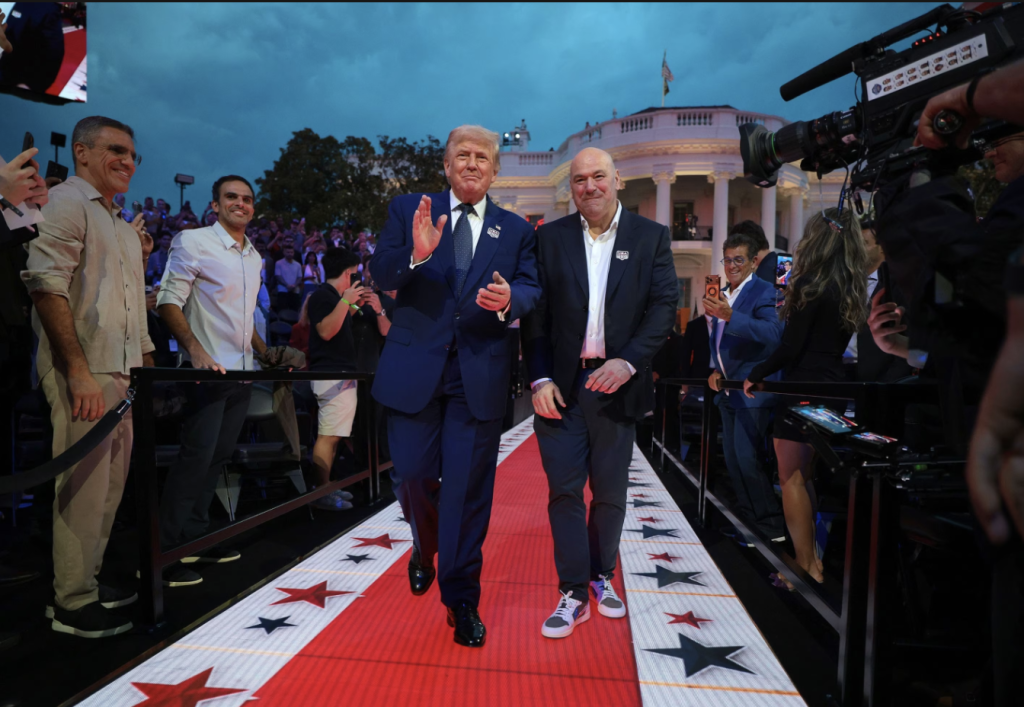
At one point early in the broadcast, the arena broke into “Happy Birthday” for Trump as he waved from his seat near Dana White. Photos and video from inside showed a crowd more like a political convention or Las Vegas high‑roller section than a typical D.C. reception, with red‑white‑and‑blue lighting framing the Octagon.
Every fight ends in a finish
Inside the cage, Freedom 250 delivered exactly what UFC had hoped for: action and stoppages. All seven fights on the main card ended by knockout or technical knockout, something White later said had not happened on a UFC card of this size in more than three decades.
The undercard saw prospects and contenders like Bo Nickal, Mauricio Ruffy, Diego Lopes, Josh Emmett and Sean O’Malley score finishes in their respective bouts. One of the night’s viral moments came when Ruffy used his post‑fight interview to propose to his girlfriend in the cage, drawing a roar from the crowd and a standing ovation from some VIP sections.
In the co‑main event, French heavyweight Ciryl Gane knocked out former two‑division champion Alex Pereira to claim an interim heavyweight belt. Gane dropped Pereira late in the second round with a straight right hand and swarmed with follow‑up strikes until the referee stepped in, briefly stunning the crowd before music and applause filled the tented arena.
Gaethje shocks Topuria in the main event
The headline ufc white house fight pitted Ilia Topuria, the undefeated lightweight champion widely ranked among the world’s best pound‑for‑pound fighters, against American veteran Justin Gaethje. Topuria, who represents Georgia and had quickly become one of UFC’s biggest global stars, walked from the Oval Office to the Octagon for his entrance, mirroring Gaethje’s path moments later.
For two rounds, the fight delivered the kind of chaos both men are known for. Gaethje pressured forward with leg kicks, body shots and looping hooks, while Topuria countered with sharp combinations. In the third round, Gaethje landed a brutal sequence that left Topuria bloodied and forced the cageside doctor to consider stopping the contest between rounds.
Topuria came out for the fourth, but the momentum had shifted. Gaethje continued to pile on damage until Topuria’s corner threw in the towel, giving Gaethje a fourth‑round TKO and the undisputed UFC lightweight title on the White House lawn. Trump stepped to the cage afterward to congratulate the new champion and posed for photos with Gaethje and White.
Dana White later called Gaethje‑Topuria “one of the greatest fights you’ll ever see” and said Freedom 250 had “exceeded all expectations.” At the same time, he told reporters at a 3 a.m. news conference that he would “never do this again,” citing the logistical and political headaches of staging UFC at the White House.
Reactions to UFC at the White House
Reactions to the ufc white house fight split along familiar cultural and political lines. Supporters saw Freedom 250 as a patriotic mash‑up of sports and celebration, a way to honor the country’s 250th birthday with a uniquely American form of entertainment. Dana White insisted the event had “no political agenda,” saying, “I love this country, and this event was for America’s 250th birthday.”
Critics questioned the symbolism of turning the South Lawn into a cage‑fighting venue and highlighted incidents they said undercut the dignity of the setting. One flashpoint came when fighter Josh Hokit used a post‑fight speech to insult former First Lady Michelle Obama, prompting widespread backlash online and in op‑eds. Others pointed to the exclusivity of the guest list and the million‑dollar ticket packages as proof that the night served wealthy supporters more than the broader public.
Commentators also noted that the same president had been loudly booed at Madison Square Garden during an NBA Finals game just days earlier, a stark contrast with the cheers from the carefully selected crowd inside The Claw. For some observers, that split captured exactly what made UFC Freedom 250 both historic and polarizing: it was a vivid snapshot of an America where politics, fandom, showmanship and power now collide in the same cage.
However people felt about it, the ufc white house fight cemented itself as one of the most unusual chapters in both White House and UFC history, a night when the South Lawn traded Easter eggs for elbows and celebrated a milestone birthday with knockouts instead of fireworks.